A verifier supplies reliable correctness, but one terminal reward cannot identify which reasoning decisions made a long trajectory useful or misleading.
FlowBalance · Tencent HY LLM Frontier · August 2026
FlowBalance: Verifier-Grounded Self-Improvement from On-Policy Reasoning Experience
Dense reasoning feedback, calibrated by verified outcomes.
FlowBalance starts from FlowRL's distributional view of reasoning and adds dense privileged supervision without introducing a separate imitation loss. Verifier advantages determine the outcome direction; a frozen self-teacher refines each sampled trajectory; and profiled trajectory balance learns the resulting reference-supported distribution over complete responses.
Part 01
Motivation
Given a problem $x$, a reasoning policy generates a complete response $y=(y_1,\ldots,y_T)\sim\pi_\theta(\cdot\mid x)$. A verifier returns an outcome $r(x,y)$—for example, whether the final answer is correct. The successful set
$$\mathcal Y^+(x)=\{y:r(x,y)=1\}$$
usually contains more than one trajectory. Two responses can reach the same correct answer through different representations, intermediate arguments, or solution strategies. Therefore, improving a reasoning model is not only about increasing $\Pr_{y\sim\pi_\theta}[r(x,y)=1]$; it is also about deciding how probability should be allocated within $\mathcal Y^+(x)$.
A solution-conditioned self-teacher can confidently support a plausible failure, suppress exploration, or collapse responses toward shorter traces.
Combine outcome advantage and token-level teacher evidence into one trajectory energy, then normalize it into a distribution over complete responses.
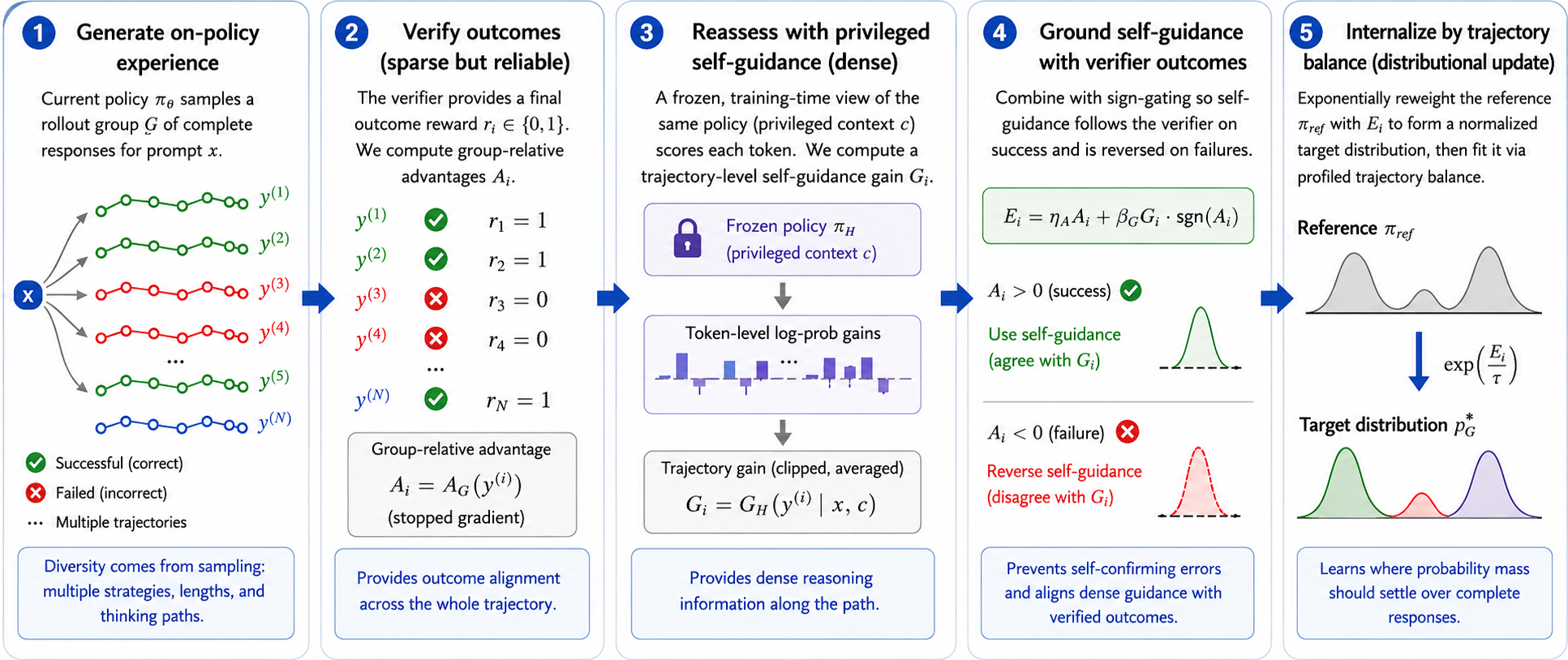
Why sparse RL and local distillation are not enough
Outcome-only RL provides direction but little information along a trajectory. Local distillation provides dense information but does not guarantee agreement with verified correctness. Adding the two as separate losses still leaves their conflict unresolved: it does not specify the normalized complete-response distribution that the policy should learn.
FlowBalance resolves the conflict at the target-design level. The verifier determines whether teacher support should reinforce or suppress a trajectory. The resulting composite energy tilts a fixed reference policy, while a shared partition value converts relative preferences into a normalized distribution for each rollout group.
Part 02
Methodology
FlowBalance starts from FlowRL and changes its response energy. For each on-policy rollout group, the verifier produces a stopped group-relative advantage $A_i$. A frozen copy of the rollout model then receives privileged context—such as a reference solution—and rescores every sampled token. The clipped average log-probability gain over the reference becomes the trajectory-level signal $G_T(y_i)$.
Generate a group of complete responses without privileged context.
Use the verifier for outcomes and the privileged teacher for dense trajectory scores.
Convert both signals into one normalized target over the sampled answers.
The resulting energy does not update the policy by itself. It first defines how much relative mass each complete response should receive:
The target distribution
$$p_i^\star=
\frac{\pi_{\mathrm{ref}}(y_i\mid x)\exp(E_i/\tau)}
{\sum_j\pi_{\mathrm{ref}}(y_j\mid x)\exp(E_j/\tau)},
\qquad
E_i=\eta_AA_i+\beta_TG_T(y_i)\operatorname{sign}(A_i).$$
$\pi_{\mathrm{ref}}$
Preserves support from the initial model instead of imitating the teacher without constraint.
$A_i$
Separates responses using verifier-derived, group-relative correctness.
$G_T(y_i)$
Summarizes dense privileged feedback over the complete sampled trajectory.
$Z_{\mathcal G}$
Turns relative preferences into a probability distribution for the prompt.
Distributional propertyFlowBalance is the smallest reference shift that reaches its energy level.+
Let $p_i^\star\propto\pi_{\mathrm{ref}}(y_i)e^{E_i/\tau}$ on the realized rollout group. For every group distribution $p$,
$$\mathrm{KL}(p\|\pi_{\mathrm{ref}})=\mathrm{KL}(p^\star\|\pi_{\mathrm{ref}})+\mathrm{KL}(p\|p^\star)+\frac{\mathbb E_p[E]-\mathbb E_{p^\star}[E]}{\tau}.$$Among distributions attaining at least the target's expected energy, $p^\star$ uniquely minimizes reverse KL to the reference.
Part 03
Trajectory Balance
FlowBalance has already defined the desired distribution over complete responses. Trajectory balance turns that distribution into a trainable condition: if the student matches the target, then every sampled response $y_i$ must satisfy
Target condition
$$\pi_\theta(y_i\mid x)
=\frac{1}{Z_{\mathcal G}(x,c)}
\pi_{\mathrm{ref}}(y_i\mid x)
\exp\!\left(\frac{E_i}{\tau}\right).$$
Taking logs and moving all terms to one side gives the trajectory-balance residual:
Trajectory-balance residual
$$\Delta_i
=\tau\log Z_{\mathcal G}
+\tau\log\frac{\pi_\theta(y_i\mid x)}{\pi_{\mathrm{ref}}(y_i\mid x)}
-E_i.$$
FlowBalance minimizes the squared residual across the rollout group:
FlowBalance objective
$$\mathcal L_{\mathrm{FlowBalance}}
=\frac{1}{2N}\sum_{i=1}^{N}\Delta_i^2.$$
Complete-response supervision
The gradient flows through the sum of student token log-probabilities, but the balance condition is imposed on the probability of the full response.
One partition per rollout group
All responses to the same prompt share $Z_{\mathcal G}$. It converts trajectory energies into a normalized distribution rather than independent scores.
Profile the unknown normalizer
Each response implies a value of $\log Z$; FlowBalance uses their group mean and stops gradients through this estimate.
Group partition estimate
$$\widehat{\log Z}_{\mathcal G}
=\frac{1}{N}\sum_{i=1}^{N}
\left[
\frac{E_i}{\tau}
-\log\frac{\pi_\theta(y_i\mid x)}{\pi_{\mathrm{ref}}(y_i\mid x)}
\right].$$
Contrast preservationProfiling one scalar $Z$ preserves every pairwise response preference.−
At zero profiled trajectory-balance loss, for every $i,j$ with positive reference support,
$$\frac{\pi_\theta(y_i\mid x)}{\pi_\theta(y_j\mid x)} =\frac{\pi_{\mathrm{ref}}(y_i\mid x)}{\pi_{\mathrm{ref}}(y_j\mid x)} \exp\!\left(\frac{E_i-E_j}{\tau}\right).$$The shared partition cancels in the ratio. It removes one common group offset while preserving all $N-1$ relative-probability directions.
Part 04
When should FlowBalance trust the privileged teacher?
Privileged likelihood and verifier correctness are different signals. A teacher may assign positive gain to a coherent-looking response that the verifier rejects. FlowBalance therefore uses the sign of $A_i$ as a gate: teacher gain raises the energy of positive-advantage responses, lowers the energy of negative-advantage responses, and vanishes when $A_i=0$.
Verified
Follow teacher support.
sign gate
Rejected
Reverse teacher pressure.
Move the weights and watch the distribution respond
This toy rollout group contains two verified answers and two rejected answers. Each starts with reference probability $\pi_{\mathrm{ref}}(y_i)$ and receives the FlowBalance energy
$$p_i^\star\propto\pi_{\mathrm{ref}}(y_i)
\exp\!\left(\eta_AA_i+\beta_TG_T(y_i)\operatorname{sign}(A_i)\right),$$
Verifier weight $\eta_A$moves mass from rejected answers toward verified answers.
Teacher weight $\beta_T$changes relative preference using privileged reasoning feedback.
Sign-gating guaranteeTeacher support on a rejected response becomes a correction favoring the verified response.+
Consider a verified response $y_+$ and a verifier-rejected response $y_-$ in the same mixed-outcome rollout group. Compared with otherwise identical ungated teacher shaping, sign gating changes their target probability ratio by
$$\frac{p^\star_{\mathrm{gated}}(y_+)}{p^\star_{\mathrm{gated}}(y_-)} =\frac{p^\star_{\mathrm{ungated}}(y_+)}{p^\star_{\mathrm{ungated}}(y_-)} \exp\!\left(\frac{2\beta_TG_T(y_-\mid x,c)}{\tau}\right).$$Thus, when the privileged teacher assigns positive gain to a rejected response, the gate converts that support from imitation pressure into a success-to-failure probability-ratio gain.
Part 05
Experiments
Across five mathematical reasoning benchmarks, FlowBalance achieves the strongest average on both Qwen3-4B and Qwen3-8B. On Qwen3-4B, its 64.26 average is +1.95 points over GRPO; on Qwen3-8B, its 67.61 average is +2.12 over GRPO. It also trains faster and more stably than GRPO while avoiding direct OPSD's response-length collapse.
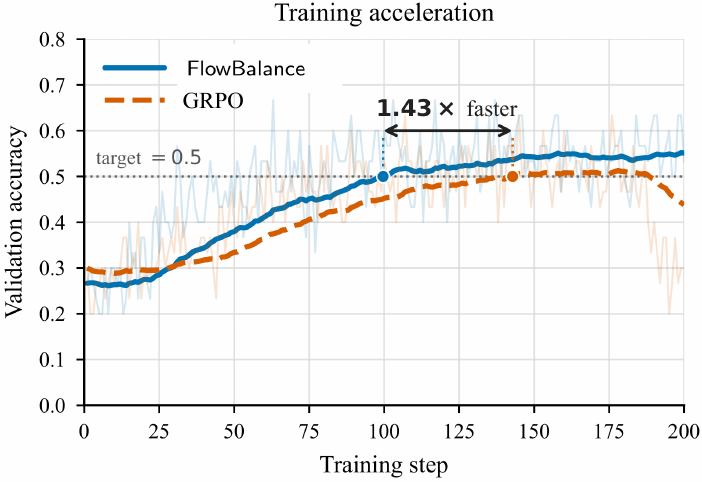
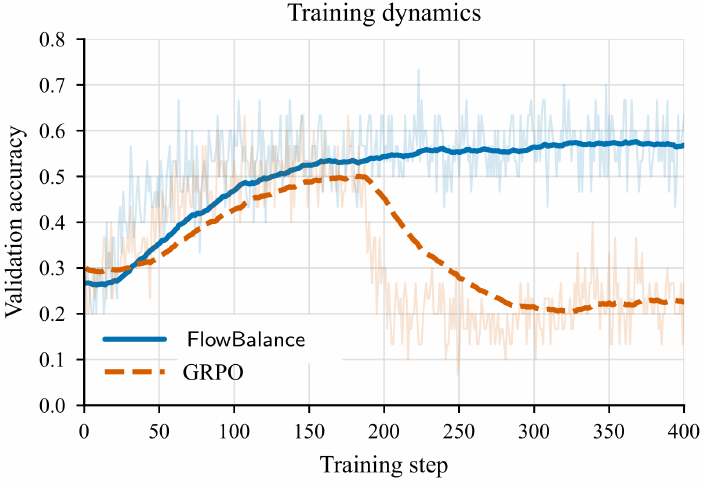
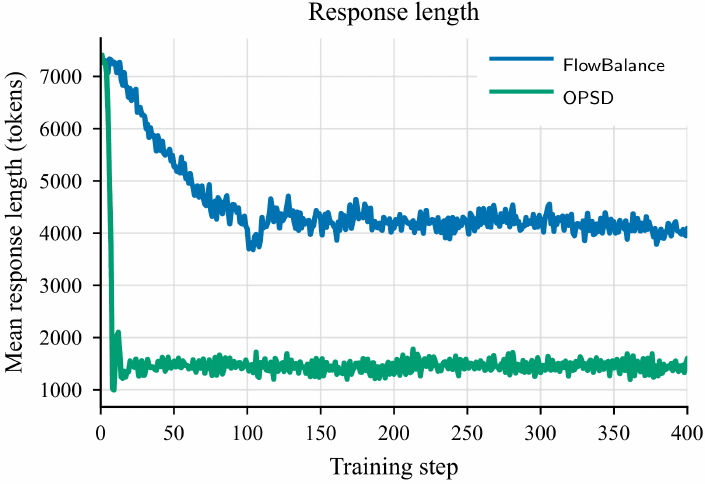
Over GRPO on the five-benchmark average (64.26 overall).
Over GRPO on the five-benchmark average (67.61 overall).
About 100 steps to 0.5 validation accuracy versus 143 for GRPO.
+ gain over GRPO- loss vs. GRPO
| Model | Method | AIME24@16 | HMMT25@1 | Minerva@1 | MATH500@1 | Olympiad@1 | Avg. |
|---|---|---|---|---|---|---|---|
| Qwen3-4B | GRPO baseline | 78.00 | 26.67 | 51.18 | 92.04 | 63.68 | 62.31 |
| OPSD | 65.33-12.67 | 14.67-12.00 | 47.28-3.90 | 87.56-4.48 | 55.76-7.92 | 54.12-8.19 | |
| RLSD | 73.33-4.67 | 21.33-5.34 | 50.29-0.89 | 91.44-0.60 | 61.36-2.32 | 59.55-2.76 | |
| FlowRL | 75.33-2.67 | 30.67+4.00 | 51.99+0.81 | 92.84+0.80 | 65.25+1.57 | 63.22+0.91 | |
| FlowBalance | 80.00+2.00 | 32.00+5.33 | 50.51-0.67 | 93.28+1.24 | 65.49+1.81 | 64.26+1.95 | |
| Qwen3-8B | GRPO baseline | 85.33 | 31.33 | 52.87 | 93.16 | 64.78 | 65.49 |
| OPSD | 48.67-36.66 | 4.00-27.33 | 38.46-14.41 | 74.56-18.60 | 40.09-24.69 | 41.16-24.33 | |
| RLSD | 82.67-2.66 | 28.00-3.33 | 52.94+0.07 | 93.44+0.28 | 63.56-1.22 | 64.12-1.37 | |
| FlowRL | 86.67+1.34 | 30.67-0.66 | 52.79-0.08 | 92.92-0.24 | 66.20+1.42 | 65.85+0.36 | |
| FlowBalance | 89.33+4.00 | 34.67+3.34 | 53.68+0.81 | 93.52+0.36 | 66.85+2.07 | 67.61+2.12 |
Part 06
Diversity Analysis
We use GPT-5.5 to extract the core mathematical representation and tools from each full AIME24 trajectory, then cluster anonymized summaries by semantic strategy rather than wording or response length. Correctness is revealed only after clustering, and diversity is computed on correct trajectories using
Simpson Diversity
$$D_{\mathrm{Simpson}}=1-\sum_{k=1}^{K}p_k^2,$$
where $p_k$ is the fraction of correct trajectories in cluster $k$; equivalently, $D_{\mathrm{Simpson}}$ is the probability that two sampled correct trajectories use different strategies.
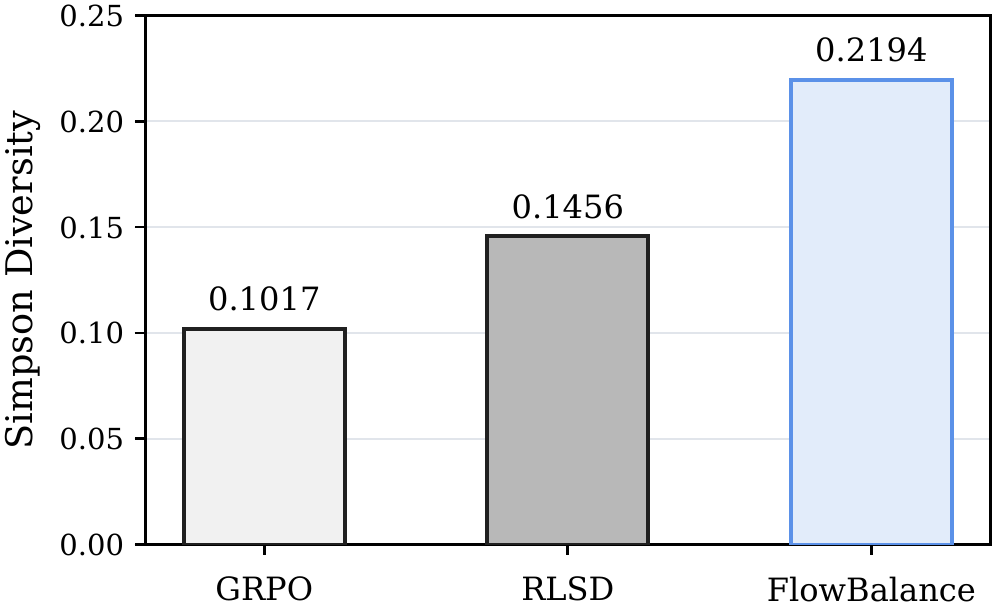
The aggregate score tells us that FlowBalance samples more varied correct strategies; the traces below show what that means mathematically. The boxed paper examples are summarized by the representation and criterion that actually drive each derivation.
Case study: the same answer through a different mathematical object
AIME24 Problem 23. A tetrahedron has opposite edge pairs $\sqrt{41}$, $\sqrt{80}$, and $\sqrt{89}$; compute its inradius expression.
Cayley–Menger determinant
Treat the tetrahedron through its six pairwise distances, build the distance matrix, exploit symmetry, and recover the volume from a distance invariant.
distance geometrydeterminantsymmetry
versus
Hidden rectangular-box embedding
Recognize $41=4^2+5^2$, $80=4^2+8^2$, and $89=5^2+8^2$; embed the vertices in a $4\times5\times8$ box and compute volume with a scalar triple product.
coordinate embeddingPythagorean structuretriple product
Result. Both routes obtain face area $24\sqrt{21}$, volume $160/3$, inradius $20\sqrt{21}/63$, and final answer $104$. The difference is structural: one treats the tetrahedron as six distances, while the other discovers a coordinate object that makes those distances immediate.
Three additional FlowBalance cases
These examples come from the same seed-0, step-180, 16-sample AIME24 run. In every pair, the final answer agrees but the central mathematical object changes.
AIME24 Problem 5. A unit-length segment joins the positive coordinate axes. Find the unique interior point of a specified segment that lies on no other segment in this family, then compute $OC^2$.
Envelope and astroid
Write the unit-intercept family as $F(x,y,u)=x/u+y/\sqrt{1-u^2}-1$. Solving $F=F_u=0$ produces the envelope $x^{2/3}+y^{2/3}=1$; the given segment corresponds to $u=1/2$.
line envelopeastroidglobal geometry
versus
Multiple-root uniqueness
Parameterize a point on the segment and require the known line to be a double root of the one-variable trigonometric incidence equation. The derivative condition gives $t=3/4$ directly.
multiplicitylocal criteriontrigonometry
Result. Both routes locate $C=(1/8,3\sqrt3/8)$, so $OC^2=7/16$ and the answer is $23$. One uses the global envelope of the whole line family; the other detects uniqueness locally through a repeated root.
AIME24 Problem 15. A radius-11 sphere is tangent to a torus generated by rotating a radius-3 circle whose center is 6 units from the axis. Compare the two contact-circle radii.
Meridian-section tangency
Slice through the rotation axis. The three-dimensional contact becomes tangency between circles of radii $3$ and $11$, whose center distances are $8$ and $14$.
2D reductioncircle tangencysimilarity
versus
Implicit-surface normals
Keep the torus and sphere as implicit surfaces in cylindrical coordinates. Collinear normals at tangency reduce the problem to $\rho/|\rho-6|=11/3$.
3D implicit geometrysurface normalselimination
Result. Both derivations give $r_i=33/4$ and $r_o=33/7$, hence $r_i-r_o=99/28$ and answer $127$. The first changes the dimension of the problem; the second solves the original surfaces through a differential tangency condition.
AIME24 Problem 27. A rhombus has vertices on $x^2/20-y^2/24=1$ and diagonals meeting at the origin. Determine the greatest number strictly below $BD^2$ for every such rhombus.
Coordinate elimination
Represent opposite vertices by $(a,b)$ and $(c,d)$, use perpendicular diagonals, and eliminate squared coordinates. This yields $BD^2=480+288000/(11a^2-720)$.
squared variablesorthogonalityalgebraic bound
versus
Secant–tangent parameterization
Parameterize the hyperbola by $(2\sqrt5\sec\theta,2\sqrt6\tan\theta)$. Perpendicularity becomes $\sin\theta\sin\phi=-5/6$, which bounds $\tan^2\phi$.
conic parameterizationtrigonometric productlimit
Result. Both routes prove $BD^2>480$ and show that values approach $480$ from above, so the requested number is $480$. Direct elimination and a parameterized conic argument reach the same sharp limit through different invariants.